Soul Accompaniment
A practice of attending to soul — the felt depth and meaning of things as they are lived.
A walking alongside.
A companioning.
A deep listening.
What is Soul Accompaniment?
Soul accompaniment (also known as spiritual direction or spiritual accompaniment) is a practice of attentive listening. Rather than offering advice or solutions, it creates a space in which the deeper movements of a person’s life can gradually become more visible. Its concern is not simply with problems, but with meaning.
An ancient practice
Across cultures and religious traditions, people have sought companions for the inner life.
In Buddhist traditions one might encounter the thera; in Sufi traditions, the shaykh; in Hindu traditions, the guru. Within Christianity there have been spiritual mothers and fathers, elders (starets and geronda), confessors, guides, and companions.
The forms differ. The impulse is remarkably similar.
A living tradition
Today this work appears in many forms. Some approaches remain closely rooted within particular religious traditions. Others have been shaped by psychology, anthropology, contemplative practice, and contemporary understandings of spirituality.
My own work has also been influenced by Jungian psychology, dreams, and Embodied Imagination, which have helped me appreciate the depth and richness of imagination within spiritual life. You can read more about this on my Dreams & Imagination page.
My own orientation
I have been shaped by both traditional and contemporary perspectives, but I do not belong narrowly to any one school. Rather than asking you to fit a particular framework, I hope to accompany you in discovering what is already seeking expression within your own life.
Every spiritual companion brings a different history, temperament, and way of listening. Finding someone who feels right for you is part of the work.
Across these many forms of accompaniment, a common thread remains: a relationship devoted to deepening one’s connection with soul, with God (or gods), with spirit, with the sacred, or simply with whatever is experienced as meaningful.
Together we listen for what in your life is seeking to be heard.

Soul
I use the word soul — not in a fixed doctrinal or metaphysical sense, but as an inclusive way of speaking about the depth and texture of meaningful experience.
Spirit & Soul
In his essay Peaks and Vales, James Hillman describes the perspective of spirit as mountain-like: concerned with ascent, transcendence, growth, and height. Yet mountains also have valleys between them, and it is there that he locates the perspective of soul.
My use of soul does not exclude spirit, but rather gives particular attention to the depth-perspectives of spiritual life.
After Religious Control
I find this breadth particularly helpful where there have been adverse religious experiences or spiritual abuse. It allows a movement away from controlling inner and outer systems and toward exploring meaning as it lives and breathes natively and uniquely within your own experience.
How Soul May Appear
Soul — and spirit — may appear through dreams, images, moods, prayer, ritual, relationship, grief, beauty, insight, struggle, nature, music, or ordinary moments of felt meaning.
What makes music soulful? A friendship good for the soul? A sunrise unexpectedly moving?
You may understand soul differently — through God, divinity, psyche, spirit, imagination, or a broader sense of the numinous.
A Shared Language
These ways of knowing are not set aside. We meet in such a way that conversation can unfold within your own language, background, and experience, so that you may be accompanied in a way that honours what is unique to you.
For me, the work is not ultimately to decide what soul is, but to remain in relationship with how it comes to us — and with how it asks to be lived.
"It is impossible to define precisely what the soul is. Definition is an intellectual enterprise anyway; the soul prefers to imagine."
Accompaniment
I lean away from the vertical hierarchies sometimes found in “spiritual direction.”
I do not position myself as a guide, nor as someone who knows more about your life than you do.
If something is offered and it resonates, we can stay with it. If it does not, it can be left aside.
This work is not about directing,
but about accompanying.
There can be a kind of quiet collapse in reducing a person to categories or conclusions — or in closing down what is still living by naming it too quickly.
Something is lost when irreducible difference is reduced to explanations, frameworks, or systems of control.
This work seeks to respond by making space for a different way of relating — a decolonising approach to spiritual life, ways of knowing, and the experience of soul.
Accompaniment begins with stopping and noticing, crossing over the invisible lines that separate us, making time to connect, to understand, and to respond.
It depends on learning about the experiences of people and listening for the kinds of assistance that are welcomed, if any.
It also crucially depends on understanding that, as far apart as our individual fates seem from one another, they are ultimately intimately connected.

What Happens in a Session
Beginning
Each session is a meeting—with you, and with what is present.
There is no fixed agenda. We begin where you are and allow time to notice what has arrived with you.
You might bring:
- something from your week
- a dream or image
- a feeling in the body
- a question without clear words
- or simply a sense that something wants attention
Staying with Experience
We stay close to what is happening rather than rushing toward explanation.
What is here now?
What seems to be asking for attention?
Sometimes we speak, ask questions, or reflect together.
Sometimes we sit quietly.
We may remain with something unclear or difficult—or make room for what wishes to be celebrated.
Ways of Working
Some sessions naturally invite more focused forms of attention.
Where appropriate we may draw on:
- dreams and imagination
- embodied awareness
- ritual or symbolic gesture
- creative response—voice, writing, or image
- silence, prayer, or contemplative attention
These are not used to fix or force an outcome, but to deepen contact.
Meaning is allowed to emerge in its own way, and in its own time.
Who This Work Might Be For
This work may resonate if:
you are seeking a place of quiet attention for your spiritual life — perhaps to deepen it, or simply to listen more closely
you are moving through a faith transition or spiritual unravelling
your faith or spiritual orientation feels unsettled or uncertain
dreams, images, memory, place, or myth feel meaningful to you
you sense that something in you — or around you — is asking for attention, without needing to be analysed or resolved
you have engaged spiritual direction before and are seeking a different kind of contemplative space
You do not need to be in crisis
Many people come simply because they sense there is more at work in their lives and desire time and space to attend to and deepen this awareness.
Others seek a reflective space to explore new ways of relating to the sacred, or to notice more closely what is unfolding within their spiritual life.
You are welcome to bring what is drawing your attention, and we attend to it together with openness and care.
If you are uncertain or have questions, you are warmly welcome to send a brief message and share what you are noticing or wondering about.
A note on scope
While there may be some overlap in a shared concern for wellbeing — and while psychology recognises the value of religious and spiritual experience — this work is not therapy. I do not offer diagnosis, treatment, or professional advice, including legal, medical, financial, or other specialist advice.

A Trauma-Informed Approach
This work is shaped by an awareness that people carry experiences which may not be fully spoken, integrated, or resolved. For this reason, the space is held with care.
At Your Own Pace
The intention is not to draw things out or push toward insight, but to allow experience to be met at a pace that feels possible.
There is no pressure to explain or disclose. What is said — and what is not said — are equally respected.
We move at the pace of your nervous system. Slowness is welcome. Pauses are welcome. There is no need to push beyond what feels steady or manageable.
Not Interpreted or Diagnosed
You are not interpreted or diagnosed. Your experience is not reduced to a framework or theory, but approached as something with its own depth and meaning.
You remain the authority in your own life. Nothing is imposed and direction is not given. If something offered does not resonate, it can simply be left aside.
Relational Awareness
Relational dynamics are held with awareness. Expectations, projections, and patterns may arise — as they do in any human encounter.
These are not taken up as authority, but approached carefully, so that your own sense of experience and agency can remain central.
The aim is not dependency, but capacity. Over time, the work seeks to support your ability to remain with your own experience, in your own way.
A Space of Accompaniment
This is not a space for fixing, solving, or directing. It is a space in which something of your life — however it appears — can be met, accompanied, and gradually come into its own depth.
If You’re Feeling Drawn
I offer a free 45-minute conversation — a chance to meet, ask questions, and get a sense of one another.
There is no expectation that you continue. It is simply a space to see whether this way of working feels right for you.
To walk beside soul is to walk attentively — with care, curiosity, and a willingness to be with what is alive.
If something in you, or in the world you are moving through, is stirring — a question, an ache, a quiet pull — you are welcome to bring it.
We can begin there.
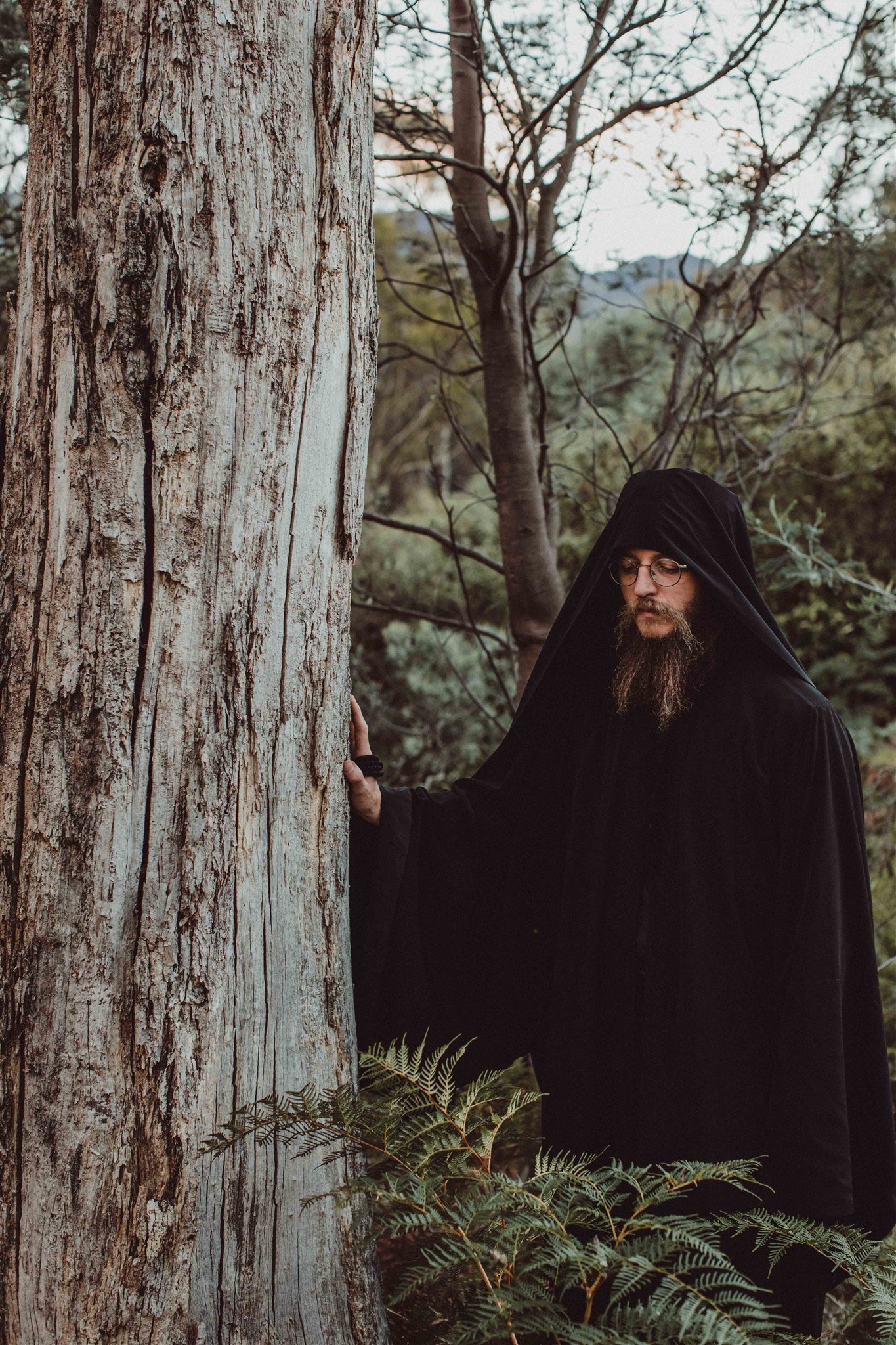
A note on this photograph
This photograph comes from an earlier period of my life in an Eastern Orthodox monastery. Monastic life remains an important part of my formation, but the clothing shown here does not indicate a current affiliation with, or representation of, a religious institution.