
Tending Dreams and Imagination
A practice of soul accompaniment: exploring ways of being with dreams and images as lived, spiritual and meaningful experiences.

Dream and Image
Episcopal priest and Jungian analyst John A. Sanford once described dreams as “God’s forgotten language.” Across cultures and throughout history, dreams have often been felt to carry a particular weight or significance within human life.
The Jewish scriptures are filled with dreams and visions. The New Testament begins with dreams given to Joseph and culminates in the visionary imagery of the Apocalypse. In ancient Mediterranean and early Christian contexts, “dream” and “vision” were often used somewhat interchangeably. They emerged from a more porous and enchanted world in which images possessed a certain potency, whether encountered in waking life or in sleep. The modern assumption that waking consciousness alone is more “real” had not yet fully taken hold.
It could be said that we do not know human life outside of image.
Across the many distinct Aboriginal cultures of Australia, concepts sometimes translated into English as the Dreaming or Dreamings concern living relationships among Country, ancestry, law, story, and presence. These traditions are not reducible to dreams in the modern psychological sense, nor do they belong within a general method of individual dreamwork. I acknowledge them here as a reminder that Western, individualised understandings of dreaming are not the only ways human communities have related to image, story, land, and reality.
Across cultures and centuries, human beings have wrestled with the mystery of dreaming and its place within the life of soul. From the interpretive manuals of Artemidorus to the visionary depths of Carl Jung’s The Red Book, dreams have been approached as revelations, symbols, encounters, warnings, inspiration, and transformation. Romanticism, Surrealism, mysticism, and political visionaries alike have all been touched by the enigma and depth that dreams can carry.
Whatever we make of them, dreams remain compelling as immediate and unbidden experiences — arising without effort, often beyond conscious control, and carrying a quality that can feel both intimate and strangely unfamiliar at once.
Many people experience dreams as an important dimension of spiritual feeling and life. It can make sense, then, to companion this half of life alongside waking thought and feeling.
Beyond the Visual Image
I am interested more broadly in image itself — not merely as something pictorial, but as something arising through all the senses: through sound, touch, smell, taste, atmosphere, memory, and imagination.
It could be said in this way that we do not know human life outside of image.
Inherited Images and Freedom
Images have long shaped human life. They have inspired devotion, guided perception, and given form to experiences that are felt yet difficult to name. At the same time, certain inherited images — especially those bound up with power, authority, or religious language — have also constrained, controlled, and at times caused harm.
Feminist and critical approaches to spiritual accompaniment and theology have drawn attention to the ways dominant images of the divine can become obstacles to relationship, particularly when they fail to reflect lived experience.
Toward Living Images
The world of image — and imagination — has long been both treasured and guarded: understood at different times as a place of revelation, temptation, creativity, danger, and encounter with the sacred.
I am especially interested in those images that arise in dream, memory, imagination, and inner life which feel less imposed and more intimately one’s own. At times these images carry a sense of something deeply personal, and yet not merely subjective — offering forms through which soul, meaning, or even the sacred may be encountered in ways that feel more native, grounded, and alive.
We’ve lost our dreams. Then they come back and we don’t know what they mean.
— The Last Wave, 1977

My Approach
Dreams, for me, are one of the most compelling dimensions of the life of soul and imagination — of spiritual meaning and a felt relationship to what has depth in life.
Dreams may or may not feel spiritually significant to you. We begin from your own experience and way of understanding.
They can weave into many other forms of spiritual and reflective practice: journalling, creativity, time in nature, silence, ritual, music, memory, or moments of quiet attention within ordinary life.
A Collaborative Approach
I hold work with dreams within the scope and practice of what I call soul accompaniment. This means the work is collaborative, reflective, and led by you. It is not a type of therapy.
My role is not to interpret, diagnose, or direct your experience, but to support you in developing your own experiential relationship with dream, image, imagination, and meaning.
You remain the final authority in relation to the personal meaning and significance of your dream. A dream may carry several possible meanings, and no particular interpretation, theory, or method is treated as final.
My own relationship to dreaming has been shaped by several different streams of practice and study.
Monastic Formation
From my years in monastic life within the Eastern Orthodox tradition, I inherited a deep concern for discernment, attentiveness, stillness, and spiritual sobriety.
Monastic life taught me to become sensitive to the subtle ways different influences, moods, images, and encounters shape one’s inner life and overall constitution.
It also formed in me a way of relating to creation — whether dream, chant, nature, memory, or feeling — as something present, alive, and carrying signals that are often only partially revealed.
At the same time, my own life gradually called me into conversation with traditions and perspectives beyond the boundaries of a single religious world.
While I remain deeply shaped by my monastic background, I do not believe any one tradition holds a monopoly on pathways of discernment or on understanding the mystery of dreams and spiritual experience.
Jung and the Unconscious
From my encounter with the work of Carl Jung, I developed an interest in what he called the unconscious — the recognition that our ordinary conscious awareness is only a small part of a much larger field, and that dreams may express dimensions of psyche or soul that otherwise remain hidden from us.
Imagination and Presence
In archetypal psychology, particularly through the work of James Hillman and the Embodied Imagination® approach developed by Robert Bosnak, I am learning new ways of relating to dreams and imagination directly, without reducing them to fixed interpretation.
Here, imagination is approached not as fantasy or escape, but as a mode of perception and a form of intelligence. Dreams may be entered as lived experiences in which images are encountered as presences carrying their own depth and perspective.
This is an experiential and phenomenological way of approaching an image—not a claim that I can determine its objective nature, establish facts from it, or tell you what it ultimately means or requires you to do. Your authority over your beliefs, interpretations, participation, and decisions remains central.
Hillman described this orientation as a “program of animism, of ensouling the non-human” — this is something that resonates deeply with me.
Rather than treating dreams as puzzles to solve or predictions to decode, I approach them as invitations into deeper listening and relationship. What matters most is cultivating a grounded and careful attentiveness to experience, while remaining open to what may gradually reveal itself over time.
There is space here to explore the richness of dream and imagination as it moves uniquely within your life.
Thoughtful. Respectful. Collaborative.
Rooted in presence and the life of the soul.
While it can be used for fantasy, illusion, make-believe, and escapism, the real work of imagination is to make contact with the strange world in which we live and to serve as both guide and inspiration for our development within it.— Gary Lachman, Lost Knowledge of the Imagination
Dreamwork in Soul Accompaniment
I’m here to walk alongside you.
I begin from not knowing
I do not assume what a dream means, and I do not interpret it for you.
The image is given room to breathe before it is explained, reduced, or made to fit a particular framework.
A dream may carry several possible meanings. You remain the final authority in relation to its personal meaning and significance within your life.
We explore together
You decide whether to share a dream, and whether to share it in whole or in part.
We follow your sense of interest and the directions the dream itself seems to invite.
Consent remains ongoing. You may slow, pause, redirect, or stop the process at any time without needing to provide a reason.
This may involve
Exploratory dialogue and sharing.
Embodied and imaginal approaches.
Creative expression, ritual, reflective practice, or simply staying with an image for a while.
We may consider how a dream relates to your felt experience, spiritual life, and ways of making meaning.
A careful and grounded practice
Dreams and imaginal practices can sometimes bring unexpected feelings, memories, bodily responses, or unsettling material into awareness. We work at a pace that supports choice and steadiness. If the process becomes overwhelming, disorienting, or no longer feels safe enough to continue, we can return to ordinary conversation, pause the practice, or stop altogether.
Dreamwork within soul accompaniment is non-clinical. It is not used to diagnose a condition, establish historical facts, recover or verify memories, predict events, determine another person’s intentions, or impose a spiritual explanation. It is not a substitute for psychotherapy, mental-health treatment, medical care, or crisis support.
Where a person’s needs fall outside the scope of this practice, another form of support may be recommended. Further information is available in the Ethics, Scope & Boundaries and Disclaimer .
Almost the greater part of mankind get their knowledge of God from dreams.
— Tertullian, De Anima, c. 210 CE
If you’re feeling drawn to this work
I offer a free 45-minute conversation — a chance to meet, ask questions, and sense whether this way of working feels right.
I encourage you to make use of this, so that we can both get a sense of whether the work is a good fit.
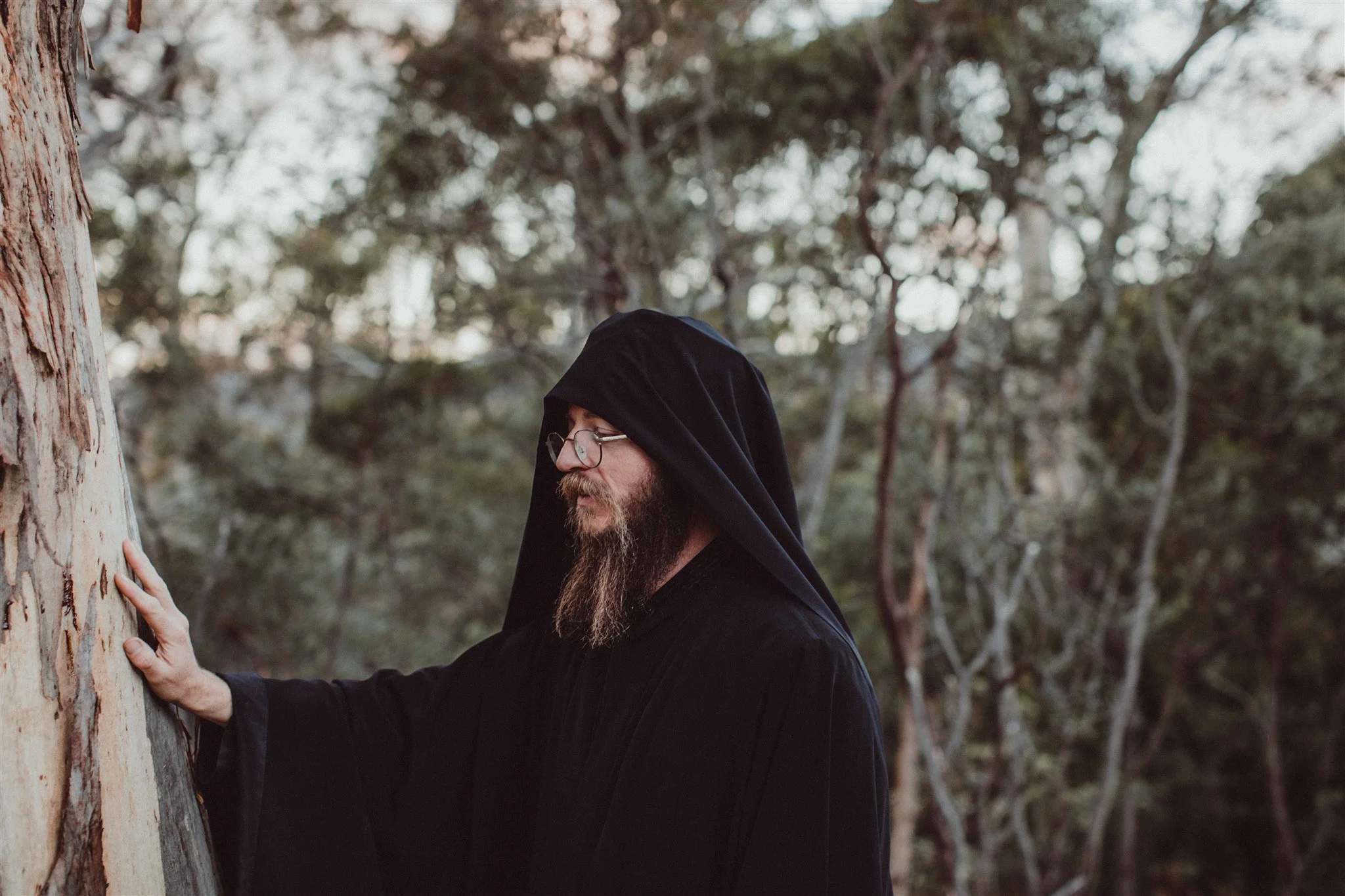
A note on this photograph
This photograph comes from an earlier period of my life in an Eastern Orthodox monastery. Monastic life remains an important part of my formation, but the clothing shown here does not indicate a current affiliation with, or representation of, a religious institution.