From our human beginnings, we have looked into the world and wondered how it came to be, and how we came to be within it. Whether young or old, the textures of life invite questions of both the particular and the mundane, and of the profoundly existential, coloured alternately by wonder and by angst. Lifting our eyes to the dark night sky, reaching at times for answers in the vast unknown, we find ourselves gathered into its blackness – each responding in our own way.
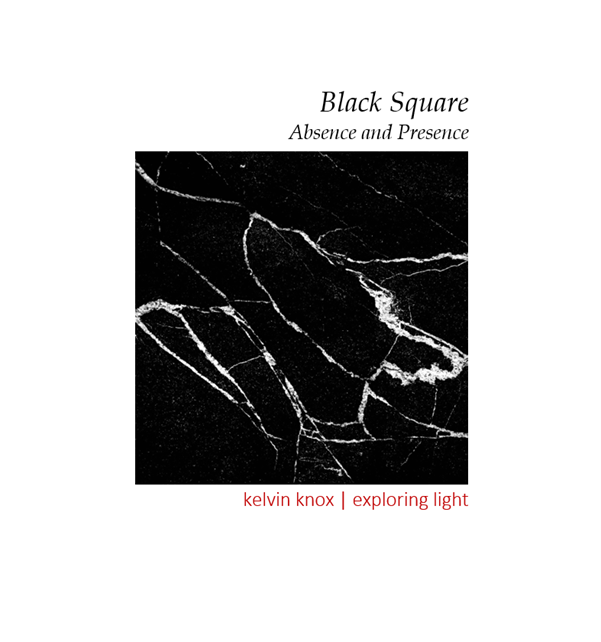
Kelvin Knox’s Black Square invites us to see black as something more than a colour and, through its images and accompanying text, suggests that black – as concept, image, and experience – can undergird a different way of asking questions. In this book, photographic art becomes a threshold experience, and black a mater with pregnant response.
Kelvin is both a photographer and a thinker, and here image is held in balance with discourse on art theory, philosophy, and science. The unique way in which he drops into the unknown provides the viewer with a dark space in which difficult questions are able to flicker upon the walls – captivating rather than merely confounding.
The questions he asks carry cosmic weight: How did the universe begin? Do we come from the blackness of the night sky? Do we return there? What of science and religion – creationism and evolution, a creator God or no God? How are we to make sense of metaphysical experience? And yet, can image really replicate the substance of these questions? Can our thinking make any sense at all of what lies beyond the physical?
Kelvin draws on Abstract Expressionism – that many-streamed movement exploring the boundary between the known and the unknown – and his work is well situated here.1 The early modernist figure Pablo Picasso once described art as ‘a form of magic that interposes itself between us and the hostile universe – a means of seizing power by imposing a form on our terrors as well as on our desires’.2 Within Abstract Expressionism, artists such as Jackson Pollock and Adolph Gottlieb – reminiscent of the Surrealist preoccupation with dream and the subconscious – engaged deeply with the writings of Carl Gustav Jung, who understood image as the primary language of archetype and the ‘Unconscious’.3
The early modern hermetic philosopher Robert Fludd’s ‘black square’ (1617) and the Suprematist pioneer Kazimir Malevich’s Black Square on a White Ground (1915) stand as immediate inspirations for Kelvin’s work. Beyond the influences Kelvin himself names, further correspondences with Fludd readily suggest themselves. Fludd, in a spirit akin to Kelvin’s own, drew upon multiple disciplines in an effort to make sense of the universe as it was understood in his day.4 Alchemy – derived from the ancient name for Egypt, Khemia, meaning ‘Black Earth’ – occupied a significant place within Fludd’s manuscripts.
Central to the alchemical process is the movement of solve et coagula: dissolution and recombination – a cycle reminiscent of the confusion, disorientation, chaos, and fertile unknowing that lie at the heart of many of Kelvin’s questions. This initial stage of blackness, or nigredo in alchemical language, precedes the beginning of the Magnum Opus – the Great Work of transformation within the alchemical tradition.5
Alchemy experienced a revival in the twentieth century through the work of Jung, who understood alchemical images as symbolic projections of unconscious psychic processes. This image-language was later taken up with particular dexterity by James Hillman, the founder of Archetypal Psychology, who emphasised the ‘de-literalizing of substantialized concepts’ – including notions such as ‘ego’ and ‘the unconscious’.6 This movement away from literalism finds a natural resonance with Malevich’s rejection of naturalistic representation in favour of elemental geometric forms, through which he sought to convey what he called ‘pure feeling’.7 Across these figures runs a shared pursuit: to discover how image might stand at the threshold between inner experience and cosmic mystery – giving visible form to what otherwise remains unspoken.
Kelvin’s questions surrounding replication and image dovetail with my own engagement with the philosophy and cultural criticism of Walter Benjamin. Benjamin writes that nature has given us a ‘gift for seeing similarity’, and more deeply still, a ‘compulsion to behave similarly – to behave mimetically’. It is through mimicry, he suggested, that we come to know ‘other.’ In his reflections on the history of the ‘mimetic faculty’, Benjamin evoked a time when this capacity was more expansive, when human beings lived within a world attuned to correspondences between microcosm and macrocosm alike.8
Wonderfully apropos to Kelvin’s work, Benjamin understood the camera as a technology capable of opening what he called the ‘optical unconscious’, writing that ‘photography reveals in this material physiognomic aspects, image worlds, which dwell in the smallest things – meaningful yet covert enough to find a hiding place in waking dreams’.9 Cultural anthropologist Michael Taussig, building on Benjamin and fascinated by technology’s ‘recharging of the mimetic faculty’, further explored this mimetic power – resisting Enlightenment abstraction in favour of the particular – and he suggested that through sensuousness, a lavishness of description,10 and exact fantasy,11 we ‘mime the real into being’.12 Mimesis thus allows us not only to represent the world but to participate in it – evoking, enchanting, and reanimating the sensuous life of things through acts of imitation and imaginative resonance.
My ongoing training in Embodied Imagination® – developed by Robert Bosnak within the broader context of Archetypal Psychology, mimesis and phenomenology – approaches image in precisely this spirit. Here one does not merely stand before an image but step into its field, allowing its sense, character, movement, emotion, and intention to unfold within le corps propre – ‘the lived body’ – which, as Maurice Merleau-Ponty taught, is a primary, preconceptual site of meaning-making.13 We are accustomed to relating to images as things ‘out there’, separable from ourselves and situated within a Cartesian subject-object split; phenomenology seeks to shift from ‘the reflective third-person perspective that tends to dominate scientific knowledge’ toward a ‘first-person point of view’.14
The twenty-first century brings new urgency to the questions Kelvin’s work addresses. Amid accelerating technologies, the rise of artificial intelligence, and bold promises of scientific transformation, many feel pulled toward polarised certainties or disenchanted withdrawal. Disorientation, loss of meaning, reactionary fundamentalism, and the hardening of otherness are not uncommon responses to the immensity of change. Yet these need not be our only responses. We stand, perhaps more than ever, before a radical unknown, and the task that remains is how to live into it with imagination rather than fear.
Over several years I have observed Kelvin’s relationship to his work: long walks tracing the contours of land; meditative silences; gazing up at the night sky; and vigorous conversations with fellow seekers. His practice bears something of Fludd’s alchemical devotion to cosmic correspondences and Malevich’s fearless opening to possibility. It has always been clear that his work is not singularly about technique or aesthetics. It is a lived journey in which conversation between media – image, word, walking, dialogue – gives birth to ongoing inquiry.
In this spirit, I invite the reader to savour Kelvin’s Black Square. Follow his work as it seeks to replicate and mime, allowing us to drop into the image itself – into the site where meaning takes form. Slow everything down. Become aware of your own body and its response to image. Let the gaze soften. Move momentarily away from interpretive haste and, through mimesis – attentive description, subtle movement, and imagination – sense its texture; feel into its character; enter its mood; explore its intention, or even its question. Allow the image itself to draw you into its perspective, into its mystery. It may be that meaning is not ultimately found in answers at all, but in the shifting of perception – in the patient dwelling with image – and in the courage to remain present at the threshold where wonder lives.